
Emergency line, 24 hours(223) 245-0005
Burst pipe, dead sump pump, a water heater that let go overnight. We pull the water out, dry the structure down to the studs and tell you straight what has to be torn out and what can stay.
Call (223) 245-0005Water in the house right now? Call and tell us what you see. We will help you stop it and plan the dry-out.
Call (223) 245-0005Water does not sit politely on the floor. It wicks up drywall, soaks carpet pad and works under baseboards, and every extra hour means more material thrown out instead of dried. The first few hours decide whether you are drying a basement or rebuilding one.
Mechanicsburg Reco handles water damage in homes and small businesses in Mechanicsburg, Shiremanstown, Camp Hill and Carlisle. We extract the water, set drying equipment and keep drying until the meter says the structure is dry.
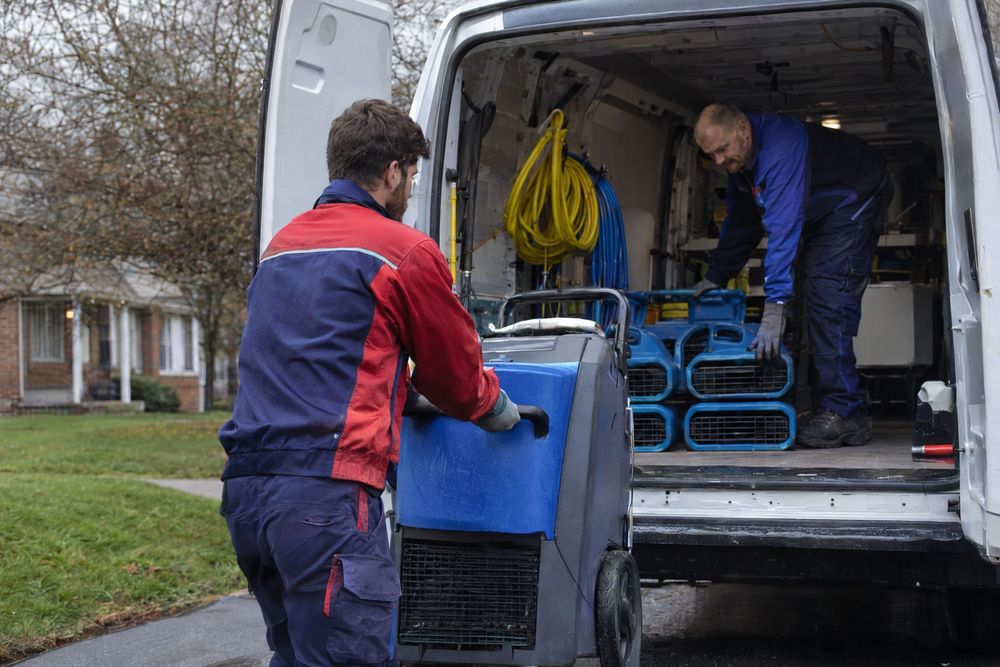
Every job starts by finding where the water came from and how far it traveled. These are the eleven things people call us for most.
| Service | What it covers |
|---|---|
| Emergency Water Extraction | Pumps and extractors to get standing water out fast, before it soaks into framing. |
| Basement Flooding Cleanup | Seepage, sump failure and groundwater in finished and unfinished basements. |
| Frozen & Burst Pipe Cleanup | Water removal and deep drying after a ruptured line floods a basement, crawlspace or wall. |
| Commercial Water Damage | Offices, shops and small buildings, with drying planned around keeping the doors open. |
| Mold Removal | Containment, removal and cleaning where water damage has let mold grow. |
| Sewage Backup Cleanup | Category 3 water: removal, disinfecting and disposal of porous materials. |
| Storm & Flood Damage | Creek overflow, heavy rain and wind-driven water getting into the house. |
| Structural Drying & Dehumidification | Air movers, dehumidifiers and moisture mapping through walls, floors and framing. |
| Ceiling & Roof Leak Damage | Wet insulation, stained or sagging drywall and water that came in from above. |
| Appliance Leak Damage | Water heaters, washers, dishwashers and refrigerator supply lines. |
| Crawlspace Water Damage | Standing water, wet insulation and damp framing under the floor. |
Nobody calls a restoration company on a good day. Every stage answers the question in your head at that moment.
The water is still coming and I do not know what to touch.
We ask where the water is, how deep it is and whether the power is still on. If a pipe is the source, we tell you where the shut-off is and what to photograph before anything moves.
You get: shut-off and safety steps before anyone arrives
It looks dry in the corner, so that part is fine, right?
Water travels. A moisture meter and a thermal camera show how far it went through walls, floors and ceilings, and we mark the line between wet and dry right on the surface.
You get: a marked boundary showing exactly where the wet stops
Are they going to rip out my whole house?
Standing water goes first. Then we pull what will not dry in place, like soaked carpet pad and drywall that has wicked water past the baseboard. Framing and most hardwood stay and get dried.
You get: a plain explanation of what comes out and why, before it comes out
How do I know it is dry inside the wall?
Air movers and dehumidifiers go in, set up following the IICRC S500 water damage standard. The goal is a reading that matches the same material in an unaffected part of your house.
You get: equipment placed for a reason, not just left running
Will mold show up a month from now?
Drying typically runs three to five days, longer for plaster, thick framing and wood floors. We log readings each visit and pull equipment only when a room reaches its dry number.
You get: a day-by-day moisture log
Will the insurance company believe me?
Your insurer decides coverage. What we control is the record: photos, readings and a written scope of work that show what happened and what it took to fix.
You get: a documentation file for your adjuster
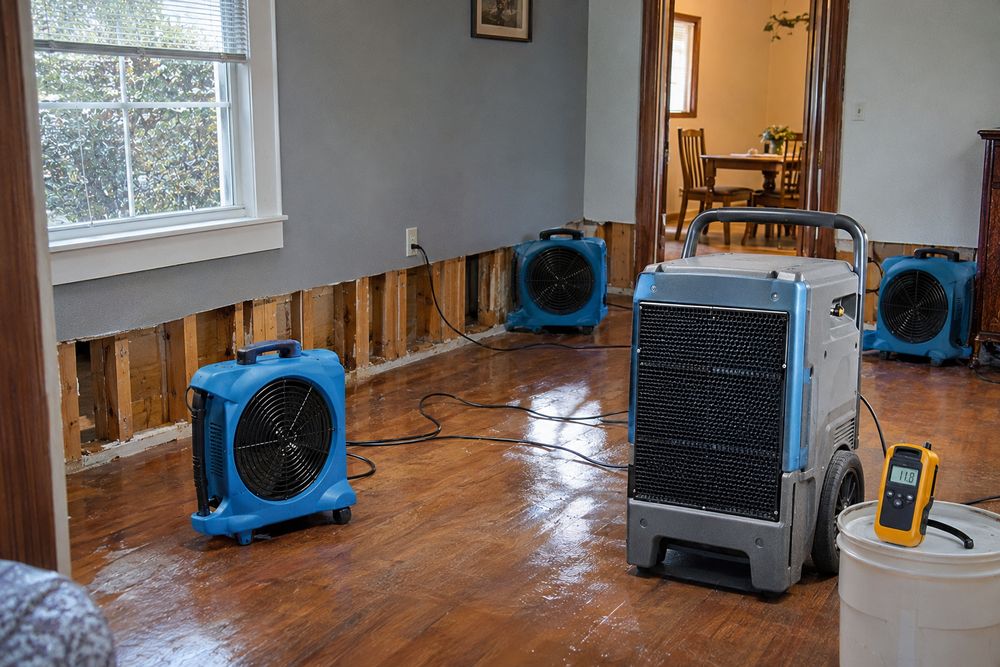
Not when the fans go quiet. Call now and we start with step one.
At the Middletown-Harrisburg weather station, the average January overnight low from 1991 through 2020 was 23.0 degrees. In a typical January the low fell to 20 or below on about 12 nights, and to 32 or below on more than 25 nights out of 31.
A pipe in an exterior wall, a crawlspace or an unheated garage does not need a deep freeze to fail. Ice blocks the line, pressure builds, and the split often shows itself only when the pipe thaws.
Average overnight low and number of days per month with a low at or below 32 degrees, Middletown-Harrisburg, 1991 to 2020. July 67.7 degrees, no freezing days. August 65.8, none. September 58.2, none. October 46.1 and 0.6 days. November 35.8 and 10.5 days. December 28.2 and 22.4. January 23.0 and 25.6. February 24.7 and 23.2. March 32.4 and 16.2. April 42.5 and 2.6. May 53.1, none. June 62.7, none. November through March are rated high risk for frozen pipes.
Source: NOAA daily minimum temperatures for the Middletown-Harrisburg area, from the Northeast Regional Climate Center (ACIS), 1991-2020. Averages calculated by Mechanicsburg Reco.
By that same record, the median last spring day at 32 degrees or lower was April 9, and the median first fall day was November 4. If a pipe has already let go, call (223) 245-0005 now, then read our frozen and burst pipe cleanup page.
Mechanicsburg became a borough in 1828. Before that it was a crossroads village on the road between Harrisburg and Carlisle, about 8 miles west of one and 10 miles east of the other. The name is traditionally tied to the wagon makers, blacksmiths and other tradesmen who worked along that route. Historians still argue about how many mechanics actually lived here.
Some of that old town is still around. Jubilee Day, the downtown street fair on the third Thursday of June, dates to the 1920s, with a pause during the Second World War. Naval Support Activity Mechanicsburg, a Navy supply installation commissioned in 1942, sits just outside the borough.
Then there is the water. The Conodoguinet Creek runs north of town, and the National Weather Service keeps a gauge on it at Hogestown, about 3 miles north of the borough. The creek drains 470 square miles there.
Eight highest crests on Conodoguinet Creek near Hogestown. June 1972, 17.01 feet, major flood, Hurricane Agnes. September 1975, 12.56 feet, major. February 1984, 12.50 feet, major. March 1952, 12.16 feet, major. September 2004, 11.35 feet, moderate. December 1934, 11.32 feet, moderate. November 1952, 10.90 feet, moderate. October 1976, 10.84 feet, moderate. Flood stage is 8 feet. The three 1934 and 1952 crests are rated less reliable by the National Weather Service.
Source: NWS Middle Atlantic River Forecast Center, historical crests, Conodoguinet Creek near Hogestown (USGS gauge 01570000), record from 1932; table dated January 2020.
NWS lists 86 floods at that gauge. The biggest by far came in June 1972, when the remnants of Hurricane Agnes pushed the creek to 17.01 feet, more than twice flood stage. Since 2000 it has crested above 10 feet in September 2004, June 2006, March 2011, September 2011 and July 2018.
You do not have to live beside the creek to feel a storm like that. Heavy rain raises groundwater, and a sump pump that has run all night can quit. See our storm and flood damage page and basement flooding page.
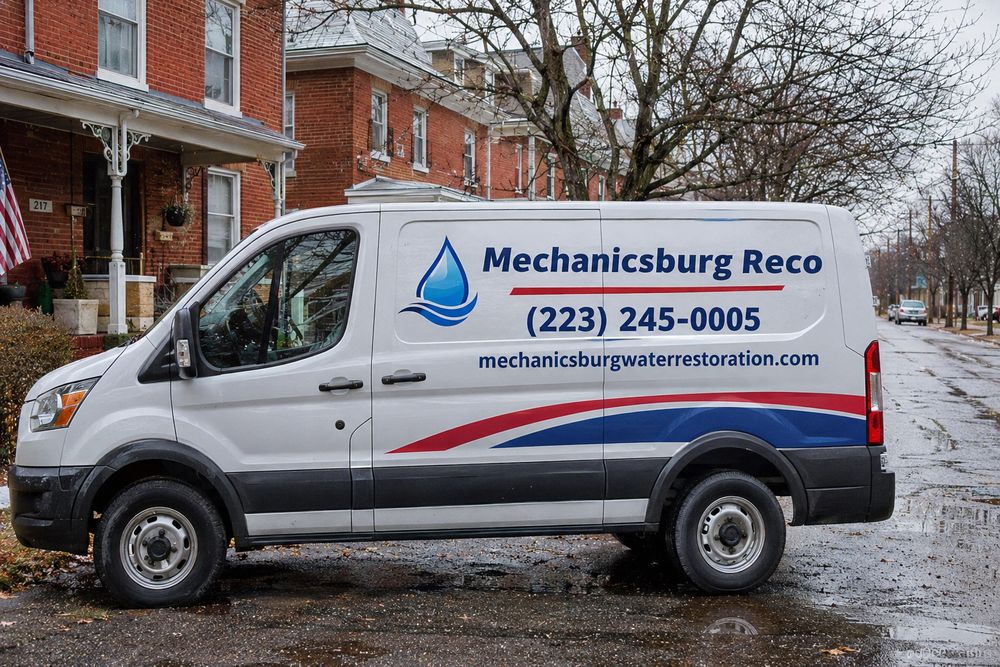
Census survey numbers show an older housing market. About a third of the borough's homes went up before 1940. Houses that old tend to carry older plumbing, older water heaters and older foundations, and those are the parts that fail.
Share of Mechanicsburg housing units by year built. Before 1940, 33.7 percent, 1,553 homes. 1940s, 4.0 percent. 1950s, 14.3. 1960s, 11.1. 1970s, 16.2. 1980s, 8.9. 1990s, 1.7. 2000s, 2.2. 2010s, 2.3. 2020 or later, 5.6. In total 2,907 homes, 63.1 percent, were built before 1970.
Source: U.S. Census Bureau, American Community Survey 5-year estimates (2020-2024), table B25034, Mechanicsburg borough, 4,605 housing units.
An older house is not a bad house. It means the first question after a leak is not only where the water went, but what it went through. A plaster wall dries differently from a drywall wall. Newer homes get hit too: see appliance leak damage.
Price depends on square footage, how long the water sat and what it passed through. A supply line caught early costs far less than a basement that sat for three days.
We give you a number after we see it.
Use the cost estimator for a rough range, or see our pricing page.
We cover the borough, the townships around it and the towns on either side. Each town has its own page.
Not sure your address is in range? Call and ask.
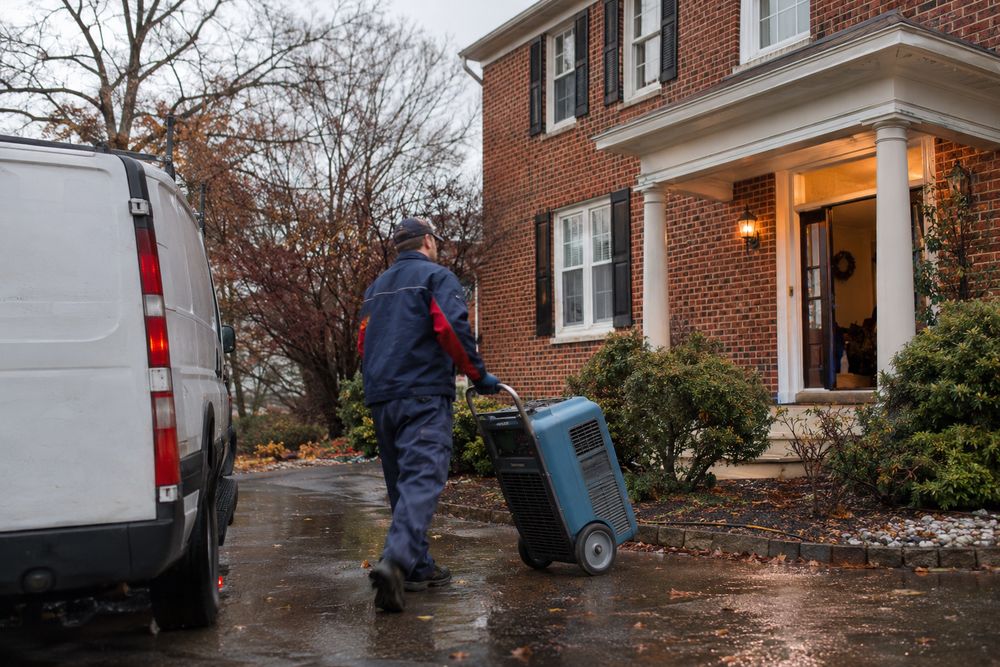
Water in the house right now? Call before you start mopping.
(223) 245-0005Fill this in and it goes straight to our inbox. For anything that is still running, spreading or smelling, skip the form and call.
Water right now? Shut off the water at the main valve if you can reach it safely, stay out of rooms where water is near outlets, then call (223) 245-0005.
Office hours are Monday through Friday, 8:00 AM to 7:00 PM. Emergency calls are answered 24 hours a day.
It depends on where the crew is and what the roads look like, so we give you a time on the phone, not a promise on a web page. Emergency calls are answered 24 hours a day.
Often it covers sudden events like a burst pipe or failed water heater, and often not slow leaks or groundwater seepage. Policies differ. Call your insurer, and we will supply the photos, readings and scope they ask for.
Most structural drying runs three to five days. Hardwood, plaster and wet insulation can take longer. We stop when the readings reach dry standard, not before.
For a small spill on a hard floor, yes. Once water has reached drywall, carpet pad or the subfloor, household equipment rarely dries the inside of the wall, and that is where mold starts.
Yes. See our commercial water damage page. We plan drying so the business can keep working where it is safe to do so.

Mechanicsburg Reco is a water damage restoration company serving Mechanicsburg, PA and nearby areas. We follow IICRC standards for water damage drying and cleanup.
Phone: (223) 245-0005
Email: info@mechanicsburgwaterrestoration.com
Mon-Fri, 8:00 AM to 7:00 PM
Emergency: 24 Hours